Meet Fran, the Whale in the Hangar
Seabird Protection Network’s Aviation Partnership Specialist Michelle Veloso spent October on the move in the Bay Area pilot community, talking with other pilots about flying the coast seabird-safe.
Recently, she gave a talk to the Bay Cities 99s at Five Rivers Aviation in Livermore. Three days later, at a separate event in Oakland, she brought along a very unexpected guest.
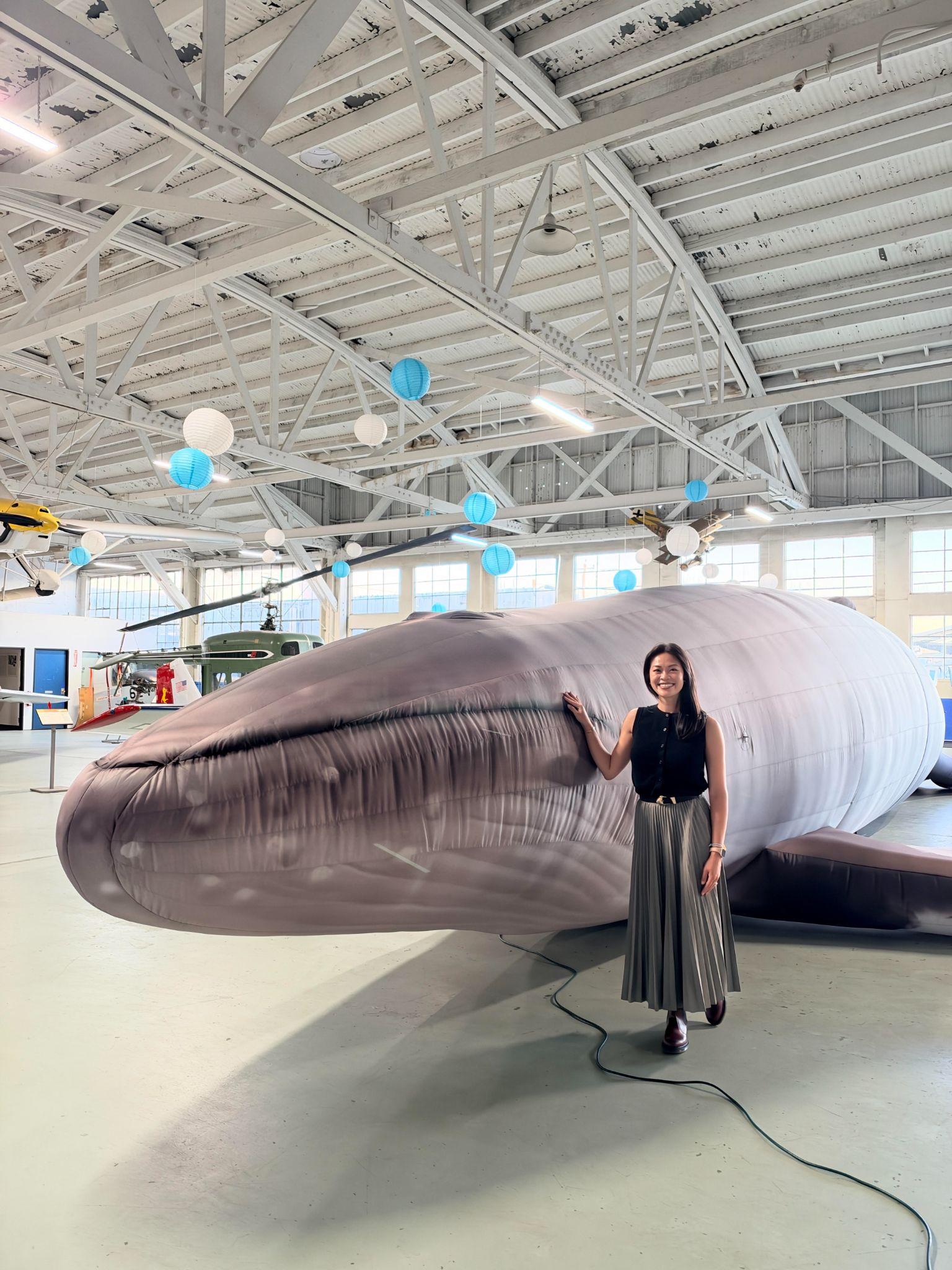
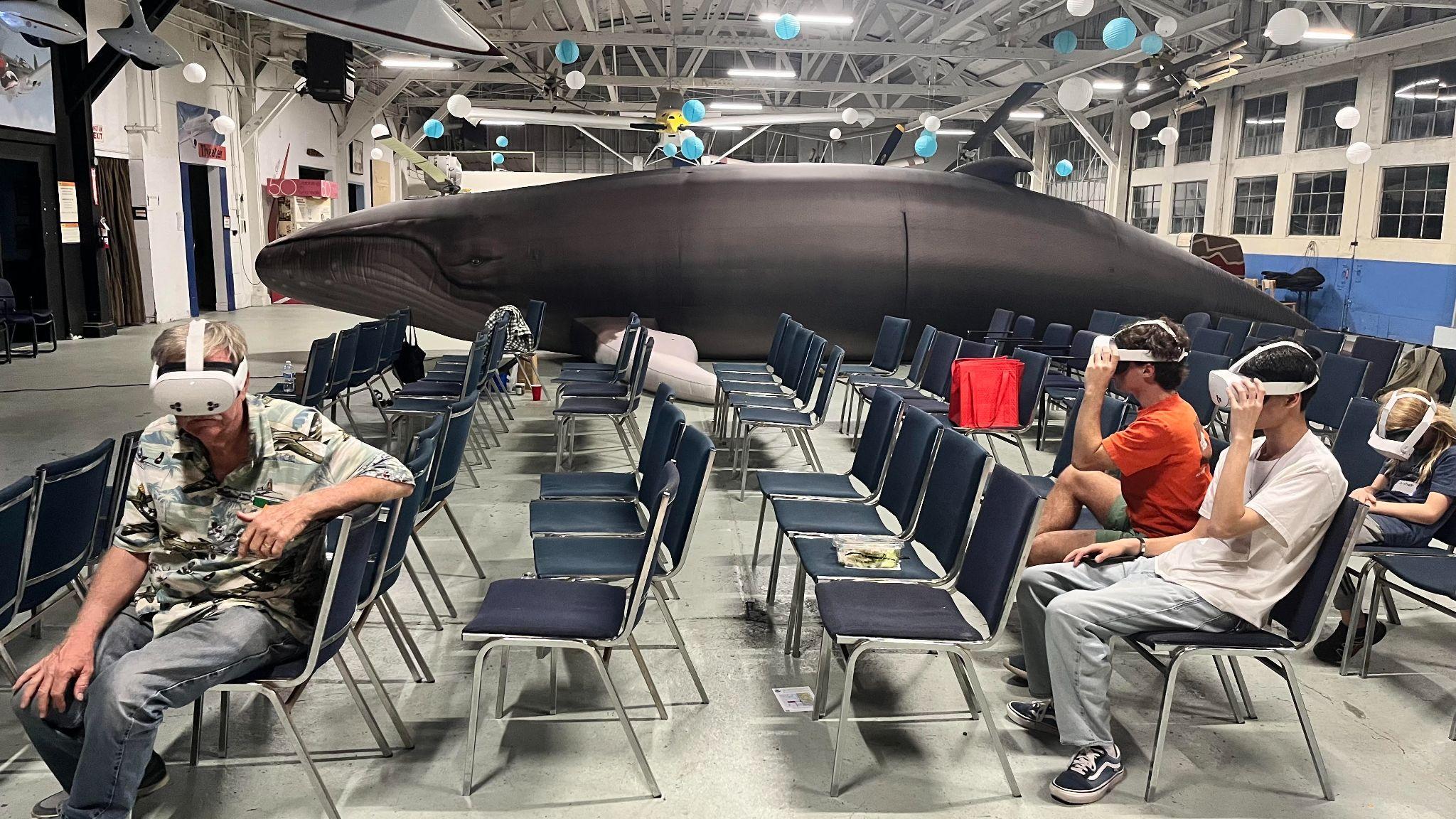
Fran is a life-sized inflatable humpback whale. On Thursday, October 15, Michelle brought her to the Oakland Aviation Museum for an evening hosted by the Oakland EAA Chapter 1686. Thirty-two people came out to meet her, mostly pilots, plus a few kids.
Named for a famous whale.
Fran is named after a real humpback, one of California’s most photographed and studied whales. She was born in 2005 to another well-known whale, Big Fin, and whale watcher Ferd Bergholz named her in honor of his late wife. She was known for her playful breaching and her distinctive fluke, mostly in Monterey Bay and off Guerrero, Mexico, and she grew to 49 feet long. To make sure it looked just like Fran, they sent in pictures to render her unique patterns on the inflatable whale.
In 2022, Fran washed up on Half Moon Bay beach. Necropsy reports showed that Fran died from a shipstrike. These valuable feeding areas often overlap with major maritime commerce which increases the risk of vessel strikes to whales. National Marine Sanctuaries have taken the lead to incentivize ships to slow down to 10 knots or less. This decreases the risk of hitting whales while also reducing ocean noise and improving air quality. If you are inspired to be a voice for the whales, reach out to Blue Whales Blue Skies. Community members, like you, can encourage shipping companies to pledge to slow down to 10 knots or less.
Bigger than the airplanes.
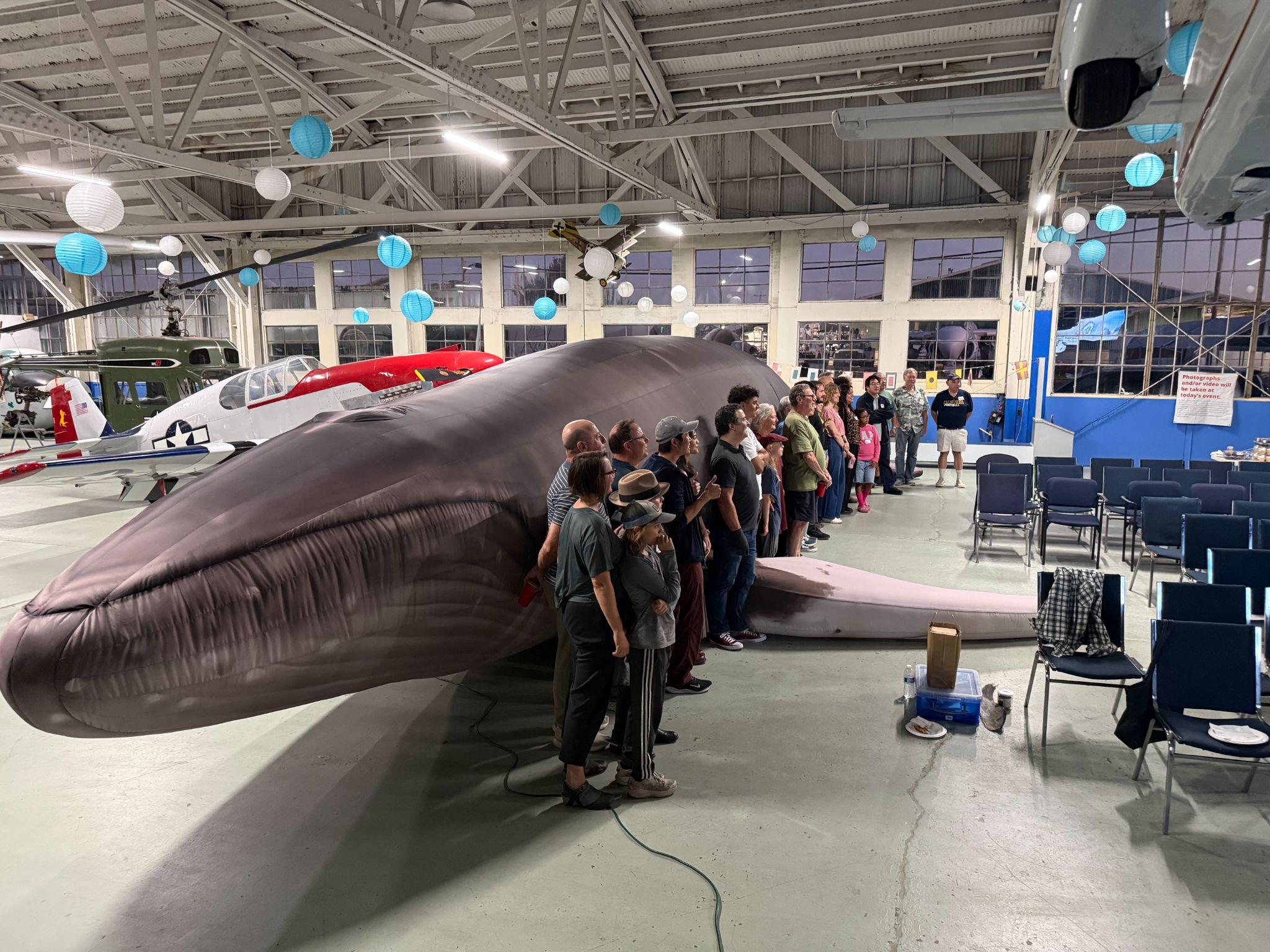
Michelle expected Fran and the aircraft to be about the same size. They weren’t. Fran was bigger than any plane in the hangar, and from the entrance, guests couldn’t see the planes behind her. From another angle, a plane hanging from the ceiling and a helicopter in the background look small beside her. As Michelle put it, Fran “just swallowed up the entire scene.”
Getting her there took some work: rolling Fran out, inflating her, and fitting her into the hangar so she looked right, then folding her back up at the end of the night.
Step inside a whale.
Guests had two exciting experiences to choose from: stepping inside Fran or using a VR headset to fly to the Farallones via a U.S. Coast Guard helicopter. Tours went 10 people at a time, shoes off, with each person slipping in quickly so Fran wouldn’t deflate.
For those who chose the VR headsets, guests watched a 10-minute video exploring the Farallon Islands’ rocky intertidal areas, including colorful tidepools.
Michelle also brought real baleen, the comb-like plates humpbacks use instead of teeth to filter their food, and a jar of real whale scat collected from the ocean’s surface. Both were crowd favorites. Fran was such a draw that Michelle deflated her before the talk began so the room would turn its attention to the presentation.
Whale watching from the cockpit.
Michelle’s talk, A Pilot’s Field Guide to the Northern California Coast, covered how to tell whales apart from the air by their spouts. A humpback’s spout is tall and straight, and it isn’t water: it’s warm breath condensing in the cool ocean air. Gray whales, here in winter and spring, have a short, heart-shaped spout. Blue whales, the largest animals ever to live, send up a huge spout and can grow to about 90 feet in the North Pacific. Humpbacks and blues are off the coast in summer and fall. Calm days are best for spotting them, since whitecaps and spouts are easy to confuse.
If you spot one, stay above 1,000 feet and skip the extra passes. A low plane can startle a whale and interrupt its feeding.
Special thanks to our partners
Fran the Whale, as well as the VR headsets, were developed by Justin Holl and Jenny Stock of the Greater Farallones and Cordell Bank National Marine Sanctuaries’ Education Team. Special thanks go out to Justin for training Michelle on how to use them.
Learn more about the Oakland EAA Chapter. If you want Michelle to bring her talk to your club or hangar, reach out. To learn more about Fran and the virtual reality program, contact Jennifer Stock and Justin Holl at jennifer.stock@noaa.gov and justin.holl@noaa.gov.